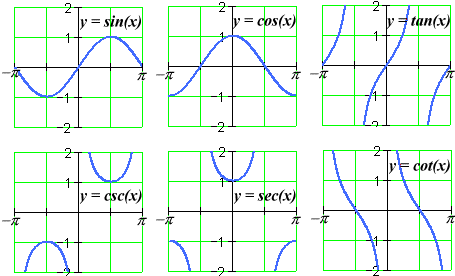
Sine and cosine don’t have asymptotes but the other trig
functions do because cosine is x/r which is x/1 and whenever a number is
imputed as x it will have a value. If it were 0 the answer would be 0. This is
the same thing for sine which is y/r or y/1 and why they don’t have asymptotes.
Sec and csc in the other hand do have asymptotes because sec is 1/cos and
whenever cosine is 0 then it is undefined which makes it an asymptote. With csc
it is 1/sin and whenever sine is 0 the answer would also have an asymptote. For
tangent it equals sin/cos and whenever cosine is 0 then the answer would be
undefined (asymptote). With cotangent it is cosine/sine and whenever sine is 0
it will also be an asymptote and why sine and cosine aren’t asymptotes but the
other 4 trig functions are.
Wednesday, April 24, 2013
Unit T Big Question #3

The normal tangent graph is uphill because tangent is the
same thing as sin/cos and when cosine equals 0 it is undefined which happens in
90 degrees (pi/2) and 270 degrees (3pi/2). Those are asymptotes and when we
graph this and label our asymptotes and follow the SATC we know that tangent is
positive because the arrow goes all the way up to the asymptote. In the other
hand cotangent is cos/sin and when sine is 0 it happens at 0 degrees, pi, and
2pi which are asymptotes and when we label that our positive is at the
asymptote towards zero and once drawn we see that it is downhill.
Unit T Big Question #2

In this picture in demonstrates both sine and cosine. Sine starts at 0 and ends in 0 because at 0 degrees in the point (1,0) sine is 0. In the other hand cosine is 1 in this point and why it starts and ends at one.
This picture is csc and it relates to sine because the reciprocal of csc is 1/sin. When we graph the sin (which is the red) we see that in order for their to be an asymptote sin has to equal 0 and in the graph that happens at 0 degrees, pi, and 2pi. From that highest point we can now draw are graph, which they reach close by the asymptotes but it doesn't touch it.
This picture shows sec and it relates to cosine because the reciprocal of sec is 1/cos. We can see the cosine in pencil and we know that for there to be an asymptote that cosine has to be 0 and why the asymptotes are at pi/2 and 3pi/2. From there we can draw our graphs. The picture shows cotangent and it relates to both cosine and sine because cotangent is the same as cos/sin and when sine is 0 then there will be an asymptote and sine is 0 at 0 degrees, pi, and 2pi. We also know that the graph has to be hear the asymptote and why the cotangent (purple) looks that way.
The picture shows tangent and it realtes to both cosine and sine because tangent is the same as sin/cos and when cosine is0 then there will be as asymptote. Cosine is 0 at pi/2 and 3pi/2. We need to lead the graph towards the asymptote and why tangent (green) looks that way.
If we also notice all of the graphs are in the upper graph because all of them are positive in the first quadrant (0 degrees-90 degrees). This pattern is shown in this graph with the All Students Take Calculus.
http://www.wmueller.com/precalculus/newfunc/invtrig.html
Monday, April 22, 2013
Unit T Big Question #1


(a) As described in the picture sine and cosine has a period of 2pi because it takes 360 degrees (2pi) for the period to repeat again. In the other hand it only takes tangent and cotangent 180 degrees (pi) for the period to repeat.
(b) In the second picture on the right cosine and sine only have amplitudes of one because it has no asymptotes and in the unit circle they both can equal 1 depending which radians. Tangent can only equal 0 or be undefined. As for csc and sec they are the reciprocals of sin and cosine and when it divided by 0 then it is undefined.
http://faculty.trevecca.edu/sstueckle/courses/Calculus/Practice_Sets/review_trig.htm
Monday, April 15, 2013
Unit S Concept 7 Assessment #4
What is this video about?
- This video is about solving equations with half-angle formulas. The video demonstrates step by step information on how to solve and what formulas were used in order to complete this problem.
- The viewer needs to pay attention and notice that in order to solve these problems they need to understand the information learned in math prior to this concept because it is essential to solving the problem. There will be references to the unit circle as well as formulas used when solving identities. In addition, everything in the video that is in purple and in red are used to identify the formulas and the steps that were used in order to solve the problem.
Thursday, April 11, 2013
Unit S Assessment #2 Student Problem
Sum Formula
Half-angle
I know these two answers are the same for sine, cosine, and tangent because when I plug it into my calculator to check if it matches with my answers the sine for when I used the sum formula and the answer I got from half-angles are the same answer. This is the same for cosine and tangent. Both ways may look like different answers, but they are the same when they are plugged into the calculator it is just a different way of getting to the solution; it still gives the same answer and how I know both ways of solving lead to the same answer.
Wednesday, April 10, 2013
Student Video #4 Unit S Concept 3 Question #1
What is this video about?
- This video teaches how to solve problems using power-reducing formulas. It demonstrates the goals that should be achieved when using power-reducing formulas as well as what steps to take to solve the problems. In addition, it shows each step in detail explaining why things are done and how they are done to solve the problem.
- The viewer needs to pay close attention to why the steps that are taken are being done. It is important to understand that our first goal is to get everything reduced to the power of one and from there reduce as further as possible. Also, understand what can be combined and what can't and the reasons behind that.
Subscribe to:
Posts (Atom)


