10. While the domain of a rational function depends on DIVAH, what do you
think the range of a rational function depends on? Give an example.
I think the range depends on the horizontal and holes. The DIVAH stands for
Domain Is Vertical Asymptotes and Holes. So the domain is connected with the
vertical asymptotes so it is only reasonable that the range is connected to the
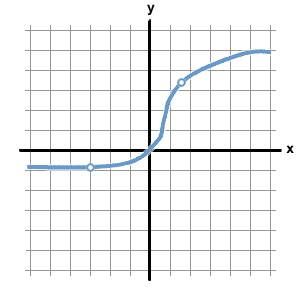
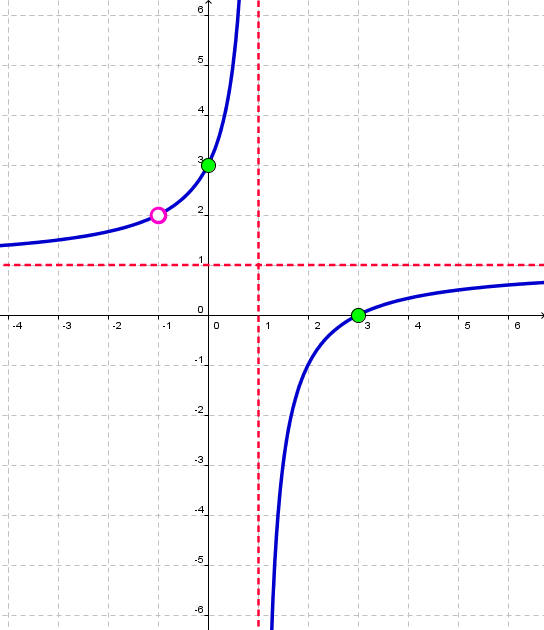
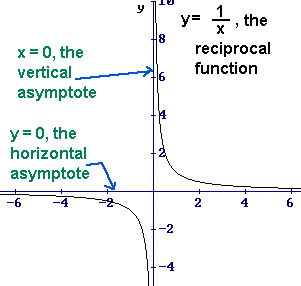
horizontal and holes. For example, in a graph the DIVAH would be drawn
vertical, up and down, to represent it. Horizontal is done in the range as a
y-intercept which is side to side and why the range would depend on the
horizontal asymptote.
Thursday, September 27, 2012
Wednesday, September 26, 2012
Unit G Summary Question #9 X-Intercepts
9. Describe how to find the x-intercepts of a rational function. Include both the long way and the shortcut way, explaining why the shortcut makes mathematical sense.
Finding the x-intercepts of a rational function you first have to simplify the equation as much as possible. Whatever is left from the problem is what you will be using to find the x-intercepts. You then equal everything to 0 and solve. You solve both the top and bottom to find the answer. The shortcut to finding the x-intercepts is that when you equal the equation to zero you just equal the top to zero because the bottom will end up canceling with the zero. So instead of multiplying both the numerator and denominator by zero you just multiply the top which will be easier and faster.
Unit G Summary Question #5 Asymptote
5. Describe the conditions in which a graph can cross through an asymptote.
A graph can cross through a horizontal asymptote when it is near the middle. In order for the graph to cross the horizontal asymptote it must be towards the middle it can’t be towards the right or the left. If it's a slant asymptote the graph can sometimes cross through an asymptote as well. For a slant asymptote it must be near the middle of the graph. Vertical asymptotes, in the other hand, the graphs can't cross through the vertical asymptotes.
STUDENT VIDEO #1: Unit F Concept 10
What is this video about?
The video is about finding all the possible zeroes that are in the equation and it demonstrates step by step what you need to know to find a zero.
What does the viewer need to pay special attention to in order to understand the concept?
The viewer needs to keep special attention that the zeroes that they get as an answer is one of the possibilities as a potential zero. If it is one of the zeroes then you know you are doing the problem right.
Tuesday, September 25, 2012
Unit G Summary Question #8 Y-Intercepts
8. How do you find the y-intercept of a rational function? Does this need to
be done in the original or simplified equation?
You find the y-intercept using the simplified part of the equation. First, you simplify the equation as much as possible into as well as canceling any numbers that will be holes. The simplified part of the equation will be where you plug in zero for every x in the simplified equation. When you plug in zero then you solve that and you will then get a number. For instance, if the number you get is 2 then your point will be (0, 2) because you are finding your y-intercept and 3 would be the y-intercept and how you find the y-intercept.
Unit G Summary Quesiton # 6 Holes
6. How do we find the appropriate place to plot a hole if the y-value is
undefined when plugged into the original equation?
We find the appropriate place to plot the hole by first factoring the equation and breaking it down as much as possible. Once you find a number or variable that is in common on both the numerator and denominator then you cancel them and they are holes of the graph. After you find the holes then you plug each of the holes into the equation that is left after simplifying as much as possible and what you get as your answer will be part of the point. So if x=0 you plug that into the equation and your answer will be (0, #) as well as the other hole and you will find your points and find the holes in the graph. To check that those are holes you plug the equation into the graphing calculator and trace that number and it shouldn't give a number for y.
Unit G Summary Question #4 Vertical Asymptote vs. Holes
4. What is the difference between a graph having a vertical asymptote and a graph having a hole?
The difference between a graph having a vertical asymptote
and a graph with a hole is that a vertical asymptote demonstrates where the
graph will approach in a certain number point. Also the graph can never cross
through a vertical asymptote. The graph may be close, but it never touches the
graph. A hole, in the other hand, demonstrates what point in the graph has an
open circle. Also when plugged into a graphing calculator and the hole is
traced there will be no y-value for it due to the hole that it has.
Monday, September 24, 2012
Unit G Summary Question #2 Limit Notation for Horizontal Asymptote
2. Describe what limit notation for horizontal asymptotes actually means.
Depending on the degree of the horizontal asymptote it will tell you what the limit notation is. If there was a bigger degree on the bottom like, x+4/x^2-5, then the equation would be y=0 which means that the limit notation, after x approaches infinity and negative infinity, it will equal a number in this case 0 since y=0. If both the bottom and top have the same degree then it is the ratio, for instance 3x^2+5x+2/x^2-4, then the ration would be 3/1 or just 3 and the limit notation would travel from infinity and negative infinity to 3. If the degree is bigger on top then there would be no asymptote and no limit notation. So limit notation is determined depending on the degree of the equation and it's location of the degrees.
Unit G Summary Question #7 Limit Notation for Vertical Asymptotes
7. Describe how to write limit notation for vertical asymptotes and what the
notation means.
When writing limit notation for a vertical asymptotes there is a new sign that goes along limit notation a + and a -. Second thing you need to know is that when you graph the equation into your graphing calculator you will see what each point does, as if it goes up or down. For example, if x=2 then your limit notation would look like, as x approaches 2+ f(x) approaches infinity. The answer is infinity if the graph would be going up for 2. Also, the small sign of "+" means it's from the right side. The small sign of "-" means it's coming from the left side. So the example done with 2 means that the 2 from the right approaches infinity because it goes up.
Sunday, September 23, 2012
Unit G Summary Question #3 Slant Asymptote
3. When does a graph have a slant asymptote? How do you find the equation of
the slant asymptote?
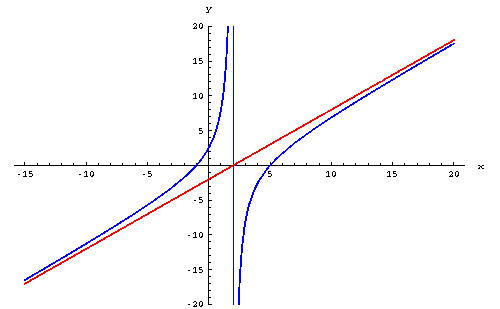
The only time that a graph has a slant asymptote is only when the degree of the top is one bigger than the degree on the bottom. If the degree was bigger on top by something more than one, like 2 or 3, on the top than the bottom then it is neither a horizontal nor a slant. A slant asymptote only exists if the degree on the numerator is one bigger. To find the equation of the slant asymptote you use long division. When you solve using long division everything in the equation is the slant asymptote except for the remainder of the equation. Graphs can cross through slant asymptote only towards the middle of the graph.
Unit G Summary Question #1 Horizontal Asymptotes
We know that a graph has a horizontal asymptote by comparing the degrees of
the numerator and the denominator. If there is a bigger degree on top (numerator)
then there is no horizontal asymptote. If both the denominator and numerator
have the same degree then the asymptote is the ration of the coefficients. If
the there is a bigger degree on the bottom (denominator) then the asymptote is
y=0. The graph sometimes crosses through the horizontal asymptotes but the
thing is that it only crosses towards the middle of the graph. The graph
doesn't cross towards the far left or the far right.
Subscribe to:
Posts (Atom)