Monday, June 3, 2013

Final Blog Post


Dear future Math Analysis Students,

In order to succeed in the flipped classroom you must not procrastinate and take responsibility of your assignments. If you are on task and watch all the videos on time and not get left behind your year will be less stressful and you will not feel overwhelmed and are more likely to succeed. In order to succeed you must have the motivation to achieve. Never give up, if you ever need help or are having trouble with a specific concept or unit that's what the flipped classroom is for, to get help in class from your peers and your teacher.

 The best way to adjust to the flip classroom is to first give it a chance and see the positives in it. Make sure you know all the things you must do as a student and the submitting requirements. Get familiar with the class and learn to accommodate to it. If you ever feel you are overwhelmed or ore confused about something you can always ask Mrs. Kirch or even your peers. The start is always the hardest but after you adjust you will be well informed and comfortable of all the things that must be done in her class in order to succeed. 

The difference from a normal classroom and a flipped classroom is that you have more responsibility in a flipped classroom. In order for you to succeed you have to make sure you get all your work done, you literally have control of how well you can succeed and the effort you put into it will determine your grade in the class. In addition, in the flipped classroom you have more opportunities to ask questions and review material that might have been forgotten about. For instance, if you forgot how to do some part of a math problem you can ask Mrs. Kirch for help, ask your peers, or re-watch the videos. You have more ways and options to ask for help in a flipped classroom.


Sincerely,

-Nancy M.

Unit V Big Question

1. When we take a point in the graph we label it (x, f(x)) and when we move the point to the left we get delta x which is another way of saying h. What connects these two points is the secant line, which goes through TWO points. We then have to find the slope where we use the formula y2-y1/x2-x1. We then plug in our (x, f(x)) into it as (x,y) in order to get the slope. This gives us f (x+h)-f(x)/h because the x’s cancel. So we also know that the smaller delta x is the more similar the secant line becomes like tangent. In order for it to work both the secant and tangent line must overlap, since tangent is only ONE point. So to find tangent all we do is take the limit as x approaches 0. We do this because we are trying to get delta x as smallest as possible that it almost reaches 0. This gets the delta x as small as possible which is what we want and where the different quotient comes from.
 

Wednesday, May 22, 2013

Unit U Big Questions


1. What is continuity? What is discontinuity?

 (a) A continuous function has no breaks, no holes, and no jumps in the graph. When drawing a continuous function you know it’s continuous if you draw it without lifting your pencil from the paper.
(b) A discontinuity is the opposite of continuity where there can be breaks and holes in the graph.


2. What is a limit? When does a limit exit? When does a limit not exist? What is the difference between a limit and a value?

 (a) A limit is the intended height of a function.
(b) A limit can exist as long as you reach the same height from both the left and right direction. Even if you were to have a hole you will still have a limit because it is the intended height, not the actual height.
(c) A limit does not exist at the 3 non-removable discontinuities; when it has a jump, is unbounded behavior, or when it is oscillating behavior.
(d) The difference between a limit and a value is that the limit is the intended height of a function while the value of the limit can be reached.


3. How do we evaluate limits numerically, graphically, and algebraically?

 (a) We evaluate limits numerically by using a table. What we do is have x be number values that are approaching the intended height and we will have f(x) be the number we get when plugged in and we find out if the limit can be reached or not.
(b) We evaluate limits graphically by either using the calculator or the picture given of the graph. When you see the two points from both sides they need to meet up at the same point if they don’t then the limit doesn’t exist.
(c) Lastly, we evaluate limits algebraically with direct substitution, dividing out/factoring method, and rationalizing/conjugate method.

 http://www.mathwords.com/d/d_assets/d74.gif
 http://media.showme.com/files/324959/pictures/thumbs/580298/last_thumb1355863924_200x150.jpg

Wednesday, April 24, 2013

Unit T Bigi Question #4


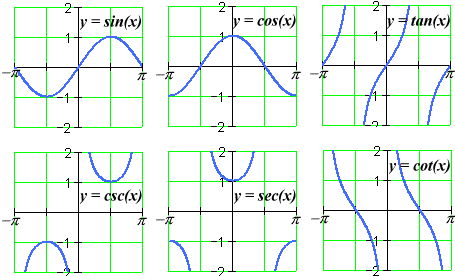
Sine and cosine don’t have asymptotes but the other trig functions do because cosine is x/r which is x/1 and whenever a number is imputed as x it will have a value. If it were 0 the answer would be 0. This is the same thing for sine which is y/r or y/1 and why they don’t have asymptotes. Sec and csc in the other hand do have asymptotes because sec is 1/cos and whenever cosine is 0 then it is undefined which makes it an asymptote. With csc it is 1/sin and whenever sine is 0 the answer would also have an asymptote. For tangent it equals sin/cos and whenever cosine is 0 then the answer would be undefined (asymptote). With cotangent it is cosine/sine and whenever sine is 0 it will also be an asymptote and why sine and cosine aren’t asymptotes but the other 4 trig functions are.

Unit T Big Question #3


The normal tangent graph is uphill because tangent is the same thing as sin/cos and when cosine equals 0 it is undefined which happens in 90 degrees (pi/2) and 270 degrees (3pi/2). Those are asymptotes and when we graph this and label our asymptotes and follow the SATC we know that tangent is positive because the arrow goes all the way up to the asymptote. In the other hand cotangent is cos/sin and when sine is 0 it happens at 0 degrees, pi, and 2pi which are asymptotes and when we label that our positive is at the asymptote towards zero and once drawn we see that it is downhill.

Unit T Big Question #2


In this picture in demonstrates both sine and cosine. Sine starts at 0 and ends in 0 because at 0 degrees in the point (1,0) sine is 0. In the other hand cosine is 1 in this point and why it starts and ends at one.  


 This picture is csc and it relates to sine because the reciprocal of csc is 1/sin. When we graph the sin (which is the red) we see that in order for their to be an asymptote sin has to equal 0 and in the graph that happens at 0 degrees, pi, and 2pi. From that highest point we can now draw are graph, which they reach close by the asymptotes but it doesn't touch it.

This picture shows sec and it relates to cosine because the reciprocal of sec is 1/cos. We can see the cosine in pencil and we know that for there to be an asymptote that cosine has to be 0 and why the asymptotes are at pi/2 and 3pi/2. From there we can draw our graphs.


The picture shows cotangent and it relates to both cosine and sine because cotangent is the same as cos/sin and when sine is 0 then there will be an asymptote and sine is 0 at 0 degrees, pi, and 2pi. We also know that the graph has to be hear the asymptote and why the cotangent (purple) looks that way.


The picture shows tangent and it realtes to both cosine and sine because tangent is the same as sin/cos and when cosine is0 then there will be as asymptote. Cosine is 0 at pi/2 and 3pi/2. We need to lead the graph towards the asymptote and why tangent (green) looks that way.


If we also notice all of the graphs are in the upper graph because all of them are positive in the first quadrant (0 degrees-90 degrees). This pattern is shown in this graph with the All Students Take Calculus.


http://www.wmueller.com/precalculus/newfunc/invtrig.html

Monday, April 22, 2013

Unit T Big Question #1


 (a) As described in the picture sine and cosine has a period of 2pi because it takes 360 degrees (2pi) for the period to repeat again. In the other hand it only takes tangent and cotangent 180 degrees (pi) for the period to repeat.
 (b) In the second picture on the right cosine and sine only have amplitudes of one because it has no asymptotes and in the unit circle they both can equal 1 depending which radians. Tangent can only equal 0 or be undefined. As for csc and sec they are the reciprocals of sin and cosine and when it divided by 0 then it is undefined.


http://faculty.trevecca.edu/sstueckle/courses/Calculus/Practice_Sets/review_trig.htm

Monday, April 15, 2013

Unit S Concept 7 Assessment #4


What is this video about?

  • This video is about solving equations with half-angle formulas. The video demonstrates step by step information on how to solve and what formulas were used in order to complete this problem.
What does the viewer need to pay attention to in order to understand the concept?
  • The viewer needs to pay attention and notice that in order to solve these problems they need to understand the information learned in math prior to this concept because it is essential to solving the problem. There will be references to the unit circle as well as formulas used when solving identities. In addition, everything in the video that is in purple and in red are used to identify the formulas and the steps that were used in order to solve the problem.

Thursday, April 11, 2013

Unit S Assessment #2 Student Problem


Sum Formula

Half-angle


I know these two answers are the same for sine, cosine, and tangent because when I plug it into my calculator to check if it matches with my answers the sine for when I used the sum formula and the answer I got from half-angles are the same answer. This is the same for cosine and tangent. Both ways may look like different answers, but they are the same when they are plugged into the calculator it is just a different way of getting to the solution; it still gives the same answer and how I know both ways of solving lead to the same answer.

Wednesday, April 10, 2013

Student Video #4 Unit S Concept 3 Question #1


What is this video about?
  • This video teaches how to solve problems using power-reducing formulas. It demonstrates the goals that should be achieved when using power-reducing formulas as well as what steps to take to solve the problems. In addition, it shows each step in detail explaining why things are done and how they are done to solve the problem.
What does the viewer need to pay attention to in order to understand the concept?
  • The viewer needs to pay close attention to why the steps that are taken are being done. It is important to understand that our first goal is to get everything reduced to the power of one and from there reduce as further as possible. Also, understand what can be combined and what can't and the reasons behind that.


Tuesday, March 26, 2013

Student Problem Unit R Concept 3 #3

  • What is this problem about?
This problem is about finding the value of an expression without using a calculator. The problem will have a reference to the unit circle to help find the degrees that will give us the point that will help solve the problem. We will be using the sun and difference formula in this question as well.

  • What does the viewer need to pay close attention to in order do the problem correctly? 
 The viewer needs to make sure and understand that when it asks, for instance, sinu= -1 and once we find that the point is (0, -1) that we know that cos is the x-value and that sin is the y-value. If the viewer notices in the picture this is how sin and cos is used and with that information we can plug it into the formula and get the correct answer.

Monday, March 25, 2013

Student Problem Unit R Concept 2 #2

  • What is this problem about?
This problem is about using the sum and difference formulas when there are given values. We are given the quadrant of the location of the values which determine the signs of the values. Depending the placement of the values will determine if sin, cos, and if tan will be either positive or negative.

  • What does the viewer need to pay clsoe attention to in order to do the problem correctly?
The viewer needs to pay attention that in order to find the other side of the triangle we needed to use the Pythagorean Theorem. Once we get an answer we also need to make sure that it is reduced as much as possible. The viewer needs to pay close attention to how the formula is written, if (u+v) is given then we write the formula that starts with u and vice verse.

Student Problem Unit R Concept 1 #1


  •  What is this problem about?
This problem is about determining how to find exact values using both sums and differences. In the first picture we took 150+60 to equal is 210 and with the unit circle we were able to find the exact values. Also if you were to subtract it, like in the second picture, we used 240-30 which is 210 and both ways will get you the same answer.

  • What does the viewer need to pay close attention to in order to do the problem correctly?
The viewer needs to pay attention that when we add the formula for sin is addition and cos is subtraction. When we take the difference though the signs change making sin be subtraction and cos addition. In addition the answers that are found can be proven by plugging it into the calculator if done correctly both answers should match.

Sunday, March 17, 2013

Math Aanalysis Reflective Blog Post

1. How have you performed on the Unit O and P tests?  What evidence do you have from your work in the unit that supports your test grade (good or bad)?  Be specific and include a minimum of three pieces of evidence.

In Unit O I did not due as well as I hoped in doing getting a 71% of the test. As for Unit P I did much better, receiving an 89% on the test. For Unit O was hurt me was not fully understanding parts of the 30-60-90 triangles and the 45-45-90 triangles which was my fault for not asking more questions of the parts that I was confused aobut. In the other hand in Unit P I understood the concepts more and took responsibility of learning the material and fully understand it. I managed my time better then
I had previously taking quizzes right when i felt comfortable with the concept. I didn't wait last minute like i did for Unit O. in addition, I asked questions about parts of the word problems that I had trouble understanding.


2. You are able to learn material in a variety of ways in Math Analysis.  It generally follows this pattern:

→ Your initial source of information is generally the video lessons and SSS packets followed by a processing and reflection activity via the WSQ
→ individual supplemental research online or in the textbook before class
→ reviewing and accessing supplementary resources provided by Mrs. Kirch on the blog
→  discussion with classmates about key concepts
→ practice of math concepts through PQs
→ formatively assessing your progress through concept quizzes
→ cumulatively reviewing material through PTs
→ Final Assessment via Unit Test.

Talk through each of the steps given in the following terms:
a. How seriously do you take this step for your learning?  What evidence do you have to support your claim?  Make sure to make reference to all 8 steps.
b. How could you improve your focus and attention on this step to improve your mastery of the material?  What specific next steps would this entail?  Make sure to make reference to all 8 steps.

A) I take some of the steps more serious than the others I feel that the videos and the SSS packet are the essential part for me to understand the material. I am serious about the other steps as well but I learn and understand the most from the videos and the SSS packet. Whenever I have trouble with a certain part of a problem I either look over the videos and if I seem not to fully understand it still that's when I feel all the other assests help me like the resources provided in the blog. whenever I have trouble I get help from my classmates through the PQ's and at times with the PT. 


B) To improve my understanding of the material I think managing my time is the most important. When I do things where I'm not in a rush I seemed to perform and understand better. finding time for myself to watch the SSS videos and not getting distracted when working on the WSQ and with the blog posts. Asking more questions in class of parts I still don't fully understand will also help me to fully see my mistakes and the thought process I should be taking in order to fully understand everything.


3. Reflect on your learning this year thus far by considering the following questions:
a.  How confident do you generally feel on the day of a Unit Test?  Give evidence and specifics to back up your answer.
b.  How well do you feel you have learned the math material this year as compared to your previous years in math? Give evidence to support your claim.
c.  How DEEPLY do you feel you have learned the math material this year as compared to your previous years in math?  Give evidence to support your claim.
d.  Do you normally feel like you understand the WHY behind the math and not just the WHAT/HOW?  Meaning, do you understand why things work, how they are connected to each other, etc, and not just the procedures?  Explain your answer in detail and cite specific evidence from this year.
e. How does your work ethic relate to your performance and success?  What is the value of work ethic in real life?
A) When I study and go over every concept the day before of the test I go into the test confident that I will do well. In most of the tests taken throughout the year I was always comfortable enough to feel confident that I will do well on the test. Every time I study i take a couple of the questions in each concept and practice them without looking at my SSS packet and if I get the answer right it makes me feel that I will do well on the test as well.

B) I feel that this year I seem to learn the material better then the previous year as well as remember how to solve it. If I were given a few problems from last year I think I would be able to solve it but probably forget parts of how to begin. This year the constant reviewing allows me to remember it better and not forget it. For instance, the review portions for the tests helps me remember how to solve for material that was learned earlier that year as well as help me remember the formula's used throughout the year. Using songs and chants to remember certain formulas did help me remember the material better.
C) I feel that I have deeply remembered the math material learned this year. It's the first time in a year long math course that I remember what we did in the beginning and middle of the year where if given problems on it I think I would be able to solve it. I can't remember what I first learned at the start of algebra 2, in this class though, I remember all the material, especially when it is brought back in the review sections on the actual tests.
D) Yes, I do think I understand the why part especially when shown examples of how it is used in real life and apply it to real life situations and objects. The math connected all year long from how the distance formula connects to trigonometry. In the unit where we learned ellipses, circles, hyperbolas, and parabolas was when we saw examples of how these shapes are applied to life. For instance, a race-car track is shaped as an ellipse demonstrating  that math is everywhere and connects to everyday things.
E) My work ethic has improved from the start of the year to fully understand the steps I have to take to succeed in this class. I feel that my work ethic demonstrates my understanding and success in the class by my test scores and my wanting to succeed. The value of work ethic in real life is working hard to accomplish your goals and taking every step possible by not giving up and having that state of mind that it is possible and you can do it.

Thursday, January 31, 2013

Ellipse Questions

  1. What is the mathematical definition of this conic section and how does that definition play a role in the properties of the conic section and how it is shaped or formed?
The mathematical definition of an ellipse is the set of all points of the distances from two fixed points is constant. Whenever you take a point in the ellipse the distance will always add up to the focus points which are constant. The definition affects how the graph will look like. The shape of the ellipse is formed depending where the bigger number is located, if under x or y. If under y then the graph will be skinny. In the other hand if the bigger number would be under x then it would be fat. Depending on the x and y will determine the type of shape the ellipse will have.


  1. How does the focus (or foci) affect the shape of the conic section?  (If you choose ellipses, you should include information about eccentricity in your response; if you choose parabolas, "p" should be a big focus... haha, get it? "p" is the distance from vertex to focus and it should be a big focus. Ok, moving on...)
The focus is inside the ellipse. The distance from the focus to any point in the ellipse will always be the same no matter where the distance is. The eccentricity of an ellipse should be under 1 and it is found by dividing c/a. Depending on the eccentricity will determine the shape of the ellipse. For instance, the bigger the eccentricity like .983 then the thinner and longer it seems to be compared to an eccentricity of .533 which may look somewhat rounder but not a circle.

  1. How do the properties of this conic section apply in real life?  (While using the exact examples I gave you may be acceptable, I will be looking for some research, creativity, and thought.  There is a lot out there!)
The properties of ellipses are everywhere for example the race track is shaped as an ellipse. The shape of the track that is shown in most races and done in competitions is shaped as an ellipse. Also, hockey rings have the shape of an ellipse. There are many things that are shaped like ellipses that we don’t even notice like the bicycle chains and the orbits of the planets. 

citations:
  •  http://mathforum.org/sanders/geometry/GP18Ellipse.html
  • https://encrypted-tbn2.gstatic.com/images?q=tbn:ANd9GcRc_CVAgh6-BZmbqowwrzzp5u1V_DcBS1PJgnyz72XeMiAZtrlEWg
  •  http://cdn1.bigcommerce.com/server5200/eaffa/products/40/images/135/new_titiam_brac__89797.1342445689.1280.1280.jpg