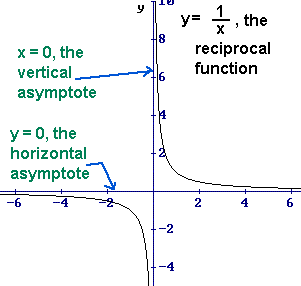
 We know that a graph has a horizontal asymptote by comparing the degrees of
the numerator and the denominator. If there is a bigger degree on top (numerator)
then there is no horizontal asymptote. If both the denominator and numerator
have the same degree then the asymptote is the ration of the coefficients. If
the there is a bigger degree on the bottom (denominator) then the asymptote is
y=0. The graph sometimes crosses through the horizontal asymptotes but the
thing is that it only crosses towards the middle of the graph. The graph
doesn't cross towards the far left or the far right.
We know that a graph has a horizontal asymptote by comparing the degrees of
the numerator and the denominator. If there is a bigger degree on top (numerator)
then there is no horizontal asymptote. If both the denominator and numerator
have the same degree then the asymptote is the ration of the coefficients. If
the there is a bigger degree on the bottom (denominator) then the asymptote is
y=0. The graph sometimes crosses through the horizontal asymptotes but the
thing is that it only crosses towards the middle of the graph. The graph
doesn't cross towards the far left or the far right. Sunday, September 23, 2012
Unit G Summary Question #1 Horizontal Asymptotes
We know that a graph has a horizontal asymptote by comparing the degrees of
the numerator and the denominator. If there is a bigger degree on top (numerator)
then there is no horizontal asymptote. If both the denominator and numerator
have the same degree then the asymptote is the ration of the coefficients. If
the there is a bigger degree on the bottom (denominator) then the asymptote is
y=0. The graph sometimes crosses through the horizontal asymptotes but the
thing is that it only crosses towards the middle of the graph. The graph
doesn't cross towards the far left or the far right. 
Subscribe to:
Post Comments (Atom)
No comments:
Post a Comment